
FEAGI
/ Fee-Ghee /The Open-Source
Brain Engine.
FEAGI (Framework for Evolutionary Artificial General Intelligence) is an open-source brain engine for robotics and embodied AI. A FEAGI brain is grown from a genome, a compact description of cortical areas, wiring rules, and plasticity, not trained from a dataset. The result is a spiking neural network that perceives, decides, and acts in real time on anything from a microcontroller to a GPU cluster.

Apache 2.0
License3 SDKs
Python · Rust · JavaREST API
Language-agnostic accessCite this work
Peer-reviewed papers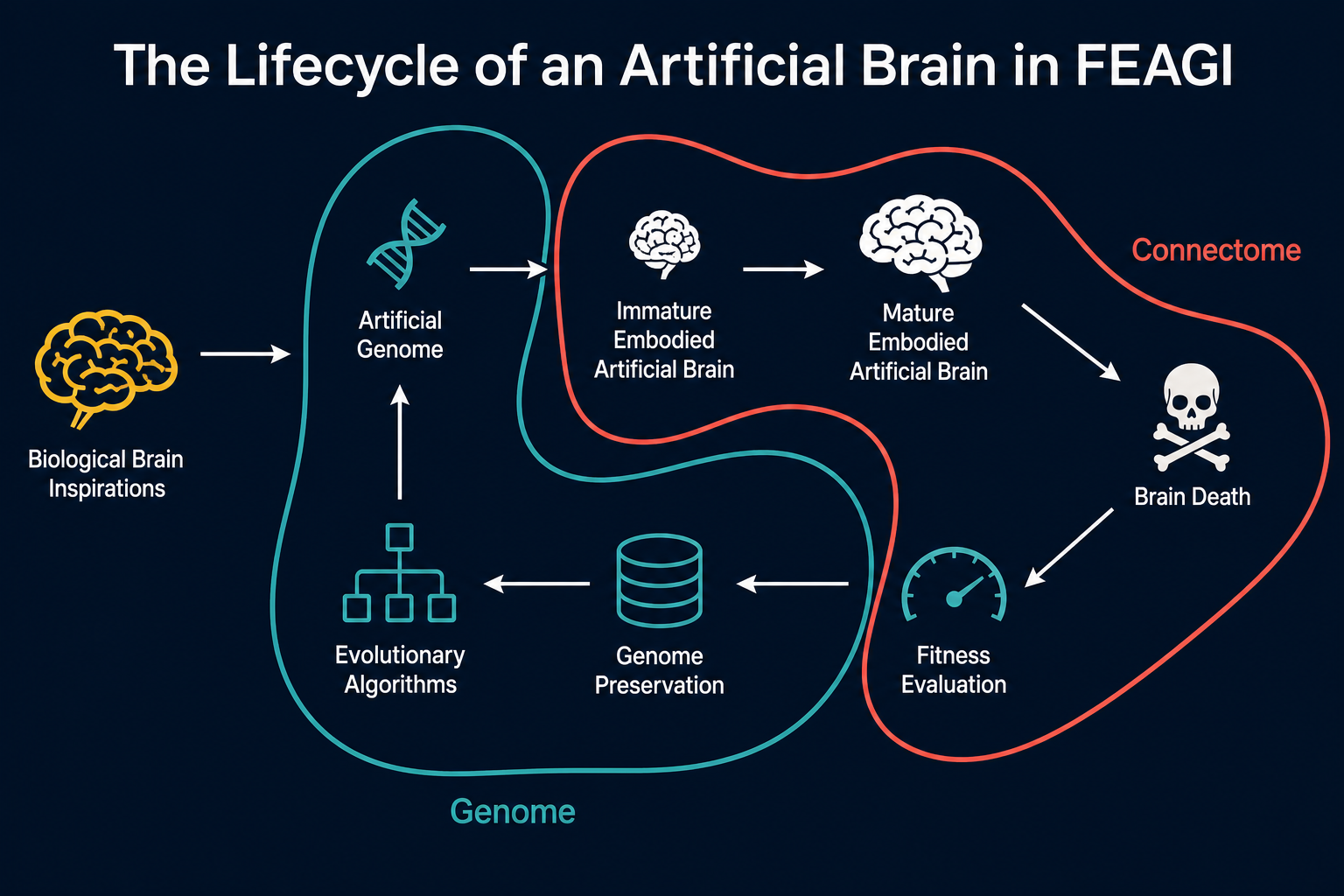
A brain that grows.
Grown, Not Trained
A FEAGI brain is defined by a genome, a compact, evolvable description of cortical areas, synaptic wiring rules, and plasticity. There is no training dataset. Structure is specified; behavior emerges. Populations of brains can be evaluated against fitness criteria, selected, and iterated, bringing evolutionary search to neural architecture design.
Spiking Neural Networks
FEAGI uses event-driven Leaky Integrate-and-Fire (LIF) neurons, a well-established biologically inspired computational model that approximates how biological neurons fire. Spikes, not matrix multiplications. Efficient, interpretable, and inherently time-aware.
Real-Time Closed Loop
Continuous perception → cognition → action at 500Hz+. FEAGI doesn't batch-process data. It senses, thinks, and acts in real time, tick by tick.
Structural Plasticity
The brain rewires itself. Neurogenesis, synaptogenesis, and STDP learning rules allow the neural architecture to evolve as the robot gains experience, not just the connection weights.
Deterministic & Auditable
Every burst cycle is deterministic, replayable, and inspectable. Critical for safety-critical robotics, hardware co-design, and research reproducibility.
Learning that never stops.
FEAGI does not separate training from inference. Every burst cycle is simultaneously a forward pass and a learning step. Synaptic weights update in real time based on spike timing, reward signals, and memory consolidation, with no gradient, no backpropagation, and no offline dataset required.
STDP — Spike-Timing-Dependent Plasticity
Synapses strengthen when a pre-synaptic neuron consistently fires just before a post-synaptic one (LTP), and weaken in the reverse order (LTD). This implements causal Hebbian learning at the level of individual spikes.
R-STDP — Reward-Modulated Learning
A scalar reward signal scales the STDP update at each synapse. Behaviors that produce positive outcomes are reinforced; maladaptive patterns are suppressed. No labeled data. No loss function.
Episodic and associative memory
FEAGI maintains layered memory: a working memory window spanning the active burst cycle, episodic traces of temporal event sequences, and long-term associative patterns formed by repeated co-activation across cortical areas.
Hierarchical consolidation
Low-level sensory spike patterns bind to higher-level abstractions through successive cortical area associations. Knowledge accumulates bottom-up, mirroring the neocortical hierarchy in biological brains.
Cortical columns, not monoliths.
Just as the human neocortex is built from repeating cortical columns, each a self-contained micro-circuit handling a slice of sensory or motor processing, FEAGI organizes intelligence as composable neuronal circuits. Small circuits are assembled into brain regions, and brain regions into full connectomes. Complexity emerges from composition, not from monolithic design.
Micro-circuits as primitives
Define a reusable sensory, memory, or motor circuit once. Instantiate it across any brain region without duplication.
Brain regions as modules
Group micro-circuits into functional regions (visual cortex, motor cortex, hippocampus analogs), each with defined input/output interfaces.
Connectomes from composition
Wire regions together via the genome to produce a complete, evolvable connectome. The same building blocks scale from a simple reflex arc to a full cognitive architecture.
Position determines connection.
In FEAGI, synaptic connections between cortical areas form through spatial morphology rules. Each rule in the genome describes a connectivity pattern for a pair of cortical areas: which source neuron positions project to which destination positions, and over what spatial extent. The same rule adapts automatically to areas of any size or shape, the same way biological axons project based on physical proximity and directionality.
Topographic projection
Scale-invariant spatial mapping between areas of any size. Neighborhood relationships are preserved regardless of resolution, modeling retinotopic, somatotopic, or any domain-specific spatial map.Receptive fields
Pattern rules wire each neuron to a defined spatial neighborhood in the destination, encoding center-surround fields, orientation columns, or any 3D spatial kernel.Directional projections
Vector-offset rules create feedforward, feedback, and lateral circuits. Lateral inhibition, predictive connections, and recurrent associations from a single directional rule.Structural patterns
Tiling, rotation, sweeping, and binary coding for complex spatial arrangements. An entire circuit topology expressed as one evolvable genome entry.Every brain grows from a blueprint.
A FEAGI brain begins as a genome: a declarative, versioned blueprint that encodes cortical architecture, neuron dynamics, and spatial connectivity rules. The genome contains no synaptic weights. It describes structure, not state. From this blueprint, neuroembryogenesis builds a live connectome through three deterministic stages — corticogenesis, neurogenesis, and synaptogenesis — using the morphology rules encoded in the genome. The resulting brain then adapts continuously through plasticity.
Diagram placeholder
Interactive genome-to-connectome diagram loads on the client.
Cortical blueprint
Every cortical area is encoded with its 3D dimensions, neuron density, firing dynamics, and plasticity mode. No weights are stored. Structure is specified; weights emerge from activity.
Connectivity rules
The cortical_mapping_dst entries in the genome define which morphology rules wire each pair of areas. The spatial wiring is derived at development time, not precomputed.
Evolvable by design
Genomes are versioned, signable, and diffable. Populations of brains can be evaluated against fitness criteria, preserved, and iterated. The separation of genotype from phenotype makes this tractable.
The clean separation of genotype from phenotype is not incidental. It is a deliberate architectural choice: brains can be compared, scored, preserved, and improved across generations, providing the foundation for genome-driven evolutionary search over brain architectures.
High-performance Rust engine
The neural computation layer is written in Rust, delivering 50–100x faster synaptic propagation than Python implementations, with no GIL, no garbage collection pauses, and cache-friendly data layouts throughout.
50–100×
faster synaptic propagation vs Python500 Hz+
burst frequency with millions of neuronsno_std
runs on ESP32, bare-metalGPU
WGPU + CUDA backends (in development)Standard codecs for any embodiment.
FEAGI ships a complete sensorimotor translation layer. Built-in encoders map raw sensor data (vision, motion, proprioception, position) into cortical neuron activity each burst cycle. Matched decoders translate brain output back into actuator commands. Pre- and post-processing pipelines run on both paths. Any embodiment that produces a supported data type connects without writing custom codec code.
Sensory encoders
What flows into the brainMotor decoders
What the brain drivesYour stack. FEAGI's intelligence.
FEAGI exposes its neural engine through official SDKs for Python, Rust, and Java, a language-agnostic REST API, a command-line interface, and an MCP server for AI assistants. All integration paths share the same underlying engine over ZMQ, WebSocket, or shared memory.
Java
<dependency>
  <groupId>org.feagi</groupId>
  <artifactId>sdk-core</artifactId>
  <version>0.0.1</version>
</dependency>
Published to Maven Central. Rust-backed I/O via JNI. Supports Linux, macOS (Intel & Apple Silicon), and Windows. Python SDK API parity.
CLI
feagi --help
feagi-java --help
Command-line interfaces for both the Python and Java SDKs. Start and stop brains, run genome uploads, trigger training cycles, and inspect runtime state without writing code.
REST API
GET /v1/cortical-area
feagi-api exposes the full engine over HTTP. Call it from any language or tool. Interactive reference and full OpenAPI 3.0 spec available at brainsforrobots.com/feagi/api-docs.
Embodiment controllers
The open-source controller library covers physical robots, simulators, and middleware bridges. Each controller connects an embodiment to the neural engine. Browse available platforms in the Embodiment Explorer, swap bodies without changing the brain, or add your own platform with a custom controller.
Physical embodiments
Connect real hardware through open-source controllers or a custom integration. The library grows with the community.Industrial & research robots
Arms, mobile platforms, and lab hardware via dedicated controllers or ROS2Edge & embedded
Microcontrollers and single-board computers running FEAGI agents on-deviceSensors & perception
LiDAR, vision, audio, and BCI inputs mapped into cortical areasSimulators
Examples with bundled controllers. Additional simulators and game engines are supported via custom integrations.MuJoCo
Physics simulation — humanoid, ant, reacherGazebo
Full robotics simulator, ROS2 nativeWebots
Open-source multi-platform robot simulatorBlender
3D environment integrationGodot
Game engine — lightweight embodimentsBuild your own
Missing your platform? Use a FEAGI SDK (Python, Rust, or Java) with the starter template to register your agent and map sensors and motors. Follow the published controller spec (required files, capabilities format, and repo layout) so your work plugs into FEAGI Core, Neurorobotics Studio, and the marketplace. Share it on GitHub or publish for one-click installs.
Controller specFrom microcontrollers to the cloud
The same neural brain runs across the full deployment spectrum. Write once, deploy anywhere. From an ESP32 on a drone to a GPU server orchestrating a robot fleet.
Embedded
ESP32 (WROOM, S3, C3), Arduino Due, Raspberry Pi Pico. no_std HAL with compile-time platform selection; new MCUs supported by implementing four platform traits.
Desktop
Linux, macOS, Windows via Neurorobotics Studio or CLI
Server / Cloud
Docker, Kubernetes, bare-metal GPU servers
FPGA
Connectome-based SNN on FPGA demonstrated at IEEE ICRC 2024
AI Accelerators
Hailo-8 integration architecture in place via NeuralAccelerator HAL trait. Coral TPU and additional inference accelerators on the roadmap.
Neuromorphic Chips
Native spike-based neuromorphic accelerators
Embedded portability is handled by feagi-hal, a no_std hardware abstraction layer that defines platform traits for time, I/O, logging, connectivity, and neural acceleration. Porting FEAGI to a new MCU requires implementing four traits against the target platform HAL. A porting guide and platform comparison are available in the feagi-core repository.
3D Brain Visualizer
Real-time 3D visualization of every cortical area, neuron, and synapse
Live neural activity: watch spikes propagate across the connectome as your robot operates
Spatial brain view + neural architecture graph in a single interactive window
Bundled with Neurorobotics Studio and available as a standalone via pip install feagi
Built on published science
FEAGI is grounded in peer-reviewed research published across IEEE and ACM journals and conferences. If you use FEAGI in academic work, please cite the relevant papers below. See the full citations and BibTeX reference page.
A Brain-Inspired Framework for Evolutionary Artificial General Intelligence
M. Nadji-Tehrani and A. Eslami
IEEE Transactions on Neural Networks and Learning Systems
@article{nadji2020brain,
  title   = {A Brain-Inspired Framework for Evolutionary Artificial General Intelligence},
  author  = {Nadji-Tehrani, Mohammad and Eslami, Ali},
  journal = {IEEE Transactions on Neural Networks and Learning Systems},
  volume  = {31},
  number  = {12},
  pages   = {5257--5271},
  year    = {2020},
  doi     = {10.1109/TNNLS.2020.2965567},
  publisher = {IEEE}
}
FEAGI: A Deterministic and Composable Neuromorphic Framework
S. S. Mondal, M. Nadji-Tehrani and H. Das
2026 IEEE 19th Dallas Circuits and Systems Conference (DCAS)
@inproceedings{mondal2026feagi,
  title     = {FEAGI: A Deterministic and Composable Neuromorphic Framework},
  author    = {Mondal, Soumik Sarkar and Nadji-Tehrani, Mohammad and Das, Hrishikesh},
  booktitle = {2026 IEEE 19th Dallas Circuits and Systems Conference (DCAS)},
  pages     = {1--4},
  year      = {2026},
  doi       = {10.1109/DCAS69364.2026.11544706},
  organization = {IEEE}
}
A Homeostatic Plasticity-Enabled CMOS Neuron for Energy-Efficient Neuromorphic Application
S. S. Mondal, M. Nadji-Tehrani, M. H. Kabir, N. N. Chakraborty and H. Das
Proceedings of the Great Lakes Symposium on VLSI 2026 (GLSVLSI '26)
@inproceedings{mondal2026homeostatic,
  title     = {A Homeostatic Plasticity-Enabled CMOS Neuron for Energy-Efficient Neuromorphic Application},
  author    = {Mondal, Soumya Swaraj and Nadji-Tehrani, Mohammad and Kabir, Md Humaun and Chakraborty, Nishith Nirjhar and Das, Hritom},
  booktitle = {Proceedings of the Great Lakes Symposium on VLSI 2026},
  pages     = {790--795},
  year      = {2026},
  doi       = {10.1145/3787109.3816390},
  address   = {Canandaigua, NY, USA},
  publisher = {ACM}
}
A Configurable CPG Controller using Connectome based SNN on FPGA for Robot Locomotion
J. Ereifej, K. Araujo, M. Nadji-Tehrani, and R. Kubendran
2024 IEEE International Conference on Rebooting Computing (ICRC)
@inproceedings{ereifej2024cpg,
  title     = {A Configurable CPG Controller using Connectome based SNN on FPGA for Robot Locomotion},
  author    = {Ereifej, Joseph and Araujo, Kevin and Nadji-Tehrani, Mohammad and Kubendran, Rajkumar},
  booktitle = {2024 IEEE International Conference on Rebooting Computing (ICRC)},
  pages     = {1--7},
  year      = {2024},
  doi       = {10.1109/ICRC64395.2024.10937017},
  organization = {IEEE}
}Apache 2.0. Free forever.
FEAGI is fully open source under the Apache 2.0 license. Use it commercially, modify it, embed it in products. The community, the controllers, and the core engine are all open — the ecosystem grows with every contributor.
Easy as 1, 2, 3
# 1. Install the Python SDK
pip install feagi

# 2. Start the engine
feagi start

# 3. Open Brain Visualizer
feagi bv start
Ready to use FEAGI?
The easiest way is through Neurorobotics Studio, a free desktop app that wraps FEAGI with a visual workspace, Brain Visualizer, and one-click embodiment connections.


New to FEAGI? Read the documentation
FEAGI — The Open-Source Brain Engine
FEAGI (Framework for Evolutionary Artificial General Intelligence) is a biologically inspired, modular neural execution engine for embodied AI and robotics. It powers perception, cognition, and control through spiking neural circuits across simulated and physical embodiments, from microcontrollers to cloud-scale deployments.
FEAGI uses event-driven Leaky Integrate-and-Fire neurons with online STDP learning, composable cortical micro-circuits, and deterministic burst cycles. SDKs are available in Python, Rust, and Java under the Apache 2.0 license.
Download Neurorobotics Studio · Explore crate architecture · Citations & research papers · FEAGI on GitHub