Integrating Webots and FEAGI
By Nathaniel Balkaran, Sophia Thompson, and Shizhen Yang
To achieve this, we developed a custom Webots controller that acts as a communication bridge between FEAGI and the simulation environment. Sensor data is extracted from the robot, then formatted so FEAGI could process and transmit to the brain. After processing, the brain's actuator commands are received and used to manipulate the robot.
Exploring Webots
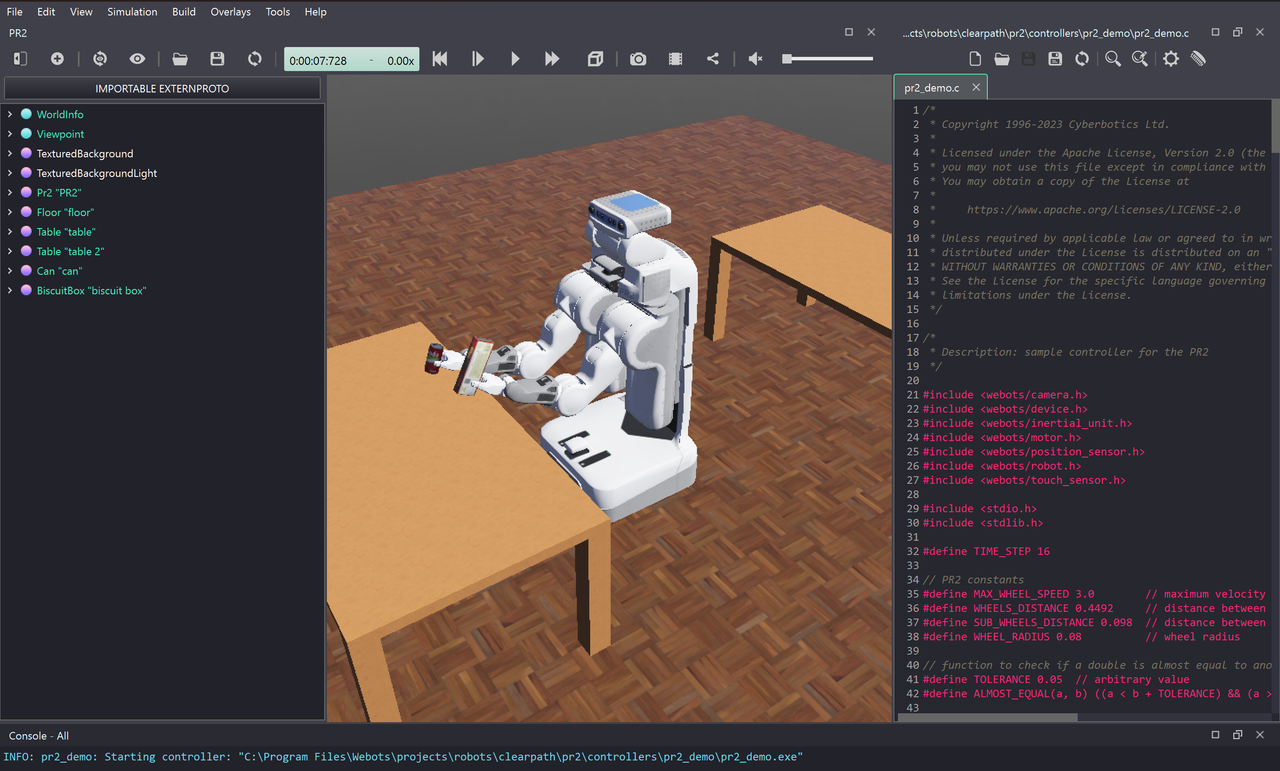
Webots provides a rich environment to simulate a wide variety of robots. Its real-time sensor and actuator interface made it a perfect match for experimenting with brain-controlled behavior. Before diving into integration, we explored the Webots system independently to get comfortable with its environment, learning how to extract and print sensor data and articulate the robot by feeding motor commands.
Development
capabilities.json file. It holds data such as the name, physical limits, or other settings for each device. We created another file that generates this JSON file and saturates it with the robot's device data we read every time the controller is executed. Webots has devices that FEAGI does not support, like GPS, brakes, speakers, and more. These devices are currently not being read by our controller, but it would be very easy to add this functionality when FEAGI has these devices supported.When speaking to FEAGI, data needs to be formatted in a specific way. For example, a problem that we faced was processing the data from camera or lidar sensors in Webots. Webots cameras send data as a string of bits in RGBA, and FEAGI needs a 2D array holding R, G, and B arrays. We needed to convert the string to properly formatted arrays, and then delete the A channel.
Genome
Challenges
We faced a few challenges while completing this project, some of which we have already mentioned above. Others are listed below.
-
Outdated Webots Documentation Some examples were broken or referenced deprecated APIs.
-
FEAGI Docker Build Issues The Docker images required manual fixes for compatibility with newer systems.
-
Continuous Camera Output Lag Streaming camera frames to FEAGI introduced noticeable latency and performance issues.
Final Thoughts
Despite challenges, we successfully achieved integration between Webots and FEAGI. Anyone curious or inspired to explore what a biologically-inspired AI-powered robot can do, now has an easy way to get started. This sets the stage for future research in learning-based behaviors, prosthetic simulations, and neuro-robotics.
This post was contributed by a member of the NRS community and reflects their own work and findings.